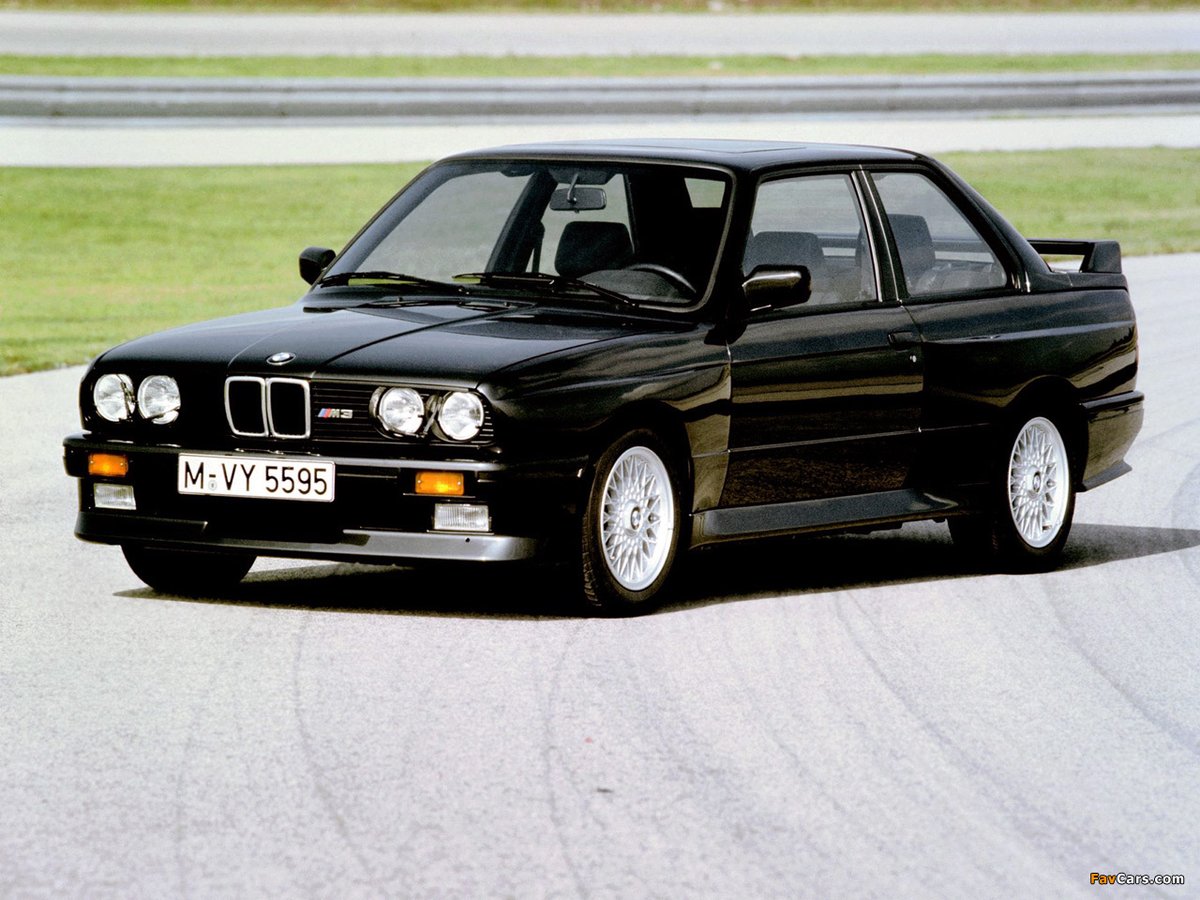
Some cars aren't just machines; they're manifestos. They scream their purpose, etched in every curve and every rev. The BMW E30 M3: The Motorsport Original (1986-1991) is precisely that kind of vehicle – a pure, unadulterated declaration of intent, born from the crucible of motorsport and refined for the street. It’s more than just a performance coupe; it's a legend, a benchmark, and a testament to BMW M’s engineering prowess that continues to captivate enthusiasts decades later.
Imagine a compact, aggressive silhouette, bulging with purpose, its engine singing a high-strung, mechanical symphony as it devours apexes. This isn't just a nostalgic fantasy; it's the visceral reality of the E30 M3. It’s the kind of car that demands engagement, rewarding those who understand its unique language with an intoxicating blend of agility, feedback, and raw, unadulterated driving pleasure.
At a Glance: The E30 M3 Essentials
- Born for the Track: Developed for FIA Group A racing, necessitating 5,000 road-going versions for homologation.
- Unique Engine: Powered by the high-revving S14 DOHC inline-4, a bespoke unit derived from BMW's racing heritage.
- Aggressive Stance: Features massively flared fenders, a distinctive rear window, and an effective trunk spoiler, all functional for performance.
- Driving Character: Known for being "buzzy" and requiring the driver to work the engine, delivering power high in the rev range.
- Racing Royalty: BMW's most successful racing car to date, a true purist's machine.
- Investment Potential: After years of fluctuating values, now considered a significant, appreciating piece of automotive history.
- Maintenance Considerations: Engine rebuilds are costly, specific parts can be pricey, and rust is a major concern on used examples.
The Genesis of a Legend: From Race Track to Road
To truly understand the E30 M3, you need to go back to its roots: the demanding world of Group A touring car racing. In the mid-1980s, BMW wanted to dominate this fiercely competitive category. Their chosen weapon? The unassuming E30 3-Series. But transforming a respectable family car into a championship contender required radical thinking, and that’s where BMW M Technical Director Paul Rosche stepped in.
The FIA Group A regulations mandated that manufacturers produce a certain number of road-legal versions of their race cars—specifically, 5,000 units—to qualify for competition. This wasn't a marketing exercise; it was a pure homologation necessity. Every aerodynamic tweak, every suspension modification, every engine upgrade on the race car had to have a direct lineage to a production model. This requirement gave birth to the E30 M3, a car so inextricably linked to its racing purpose that its road-going version feels like a thinly veiled race car for the street. It was designed, from the ground up, to win.
Under the Hood: The S14 Heartbeat
At the core of the E30 M3’s motorsport DNA lies its remarkable engine: the S14. Unlike many performance variants that share engines with their tamer siblings, the M3's S14 was a unique beast. It started with the block from the M10 four-cylinder engine (a proven, robust design), but then received a bespoke 16-valve cylinder head derived from the legendary M1 and M5's M88/S38 inline-six. This cross-pollination resulted in a high-revving, naturally aspirated 2.3-liter DOHC inline-4 that, in its initial street guise, produced around 200 horsepower (192 hp for early US models).
Don't let the horsepower figure fool you; this wasn't about brute force. The S14 was designed for efficiency and responsiveness, delivering its power higher in the rev range. It was a unit that loved to be pushed, providing a distinct, mechanical soundtrack as it climbed towards its redline. This character is what truly differentiates it and makes driving an M3 such a uniquely engaging experience, a trait explored further when considering the iconic S14 engine.
Engineered for the Track, Mastered on the Street
The E30 M3’s race-bred origins are immediately evident in its visual and mechanical distinctions from the standard E30. This wasn't just a body kit slapped onto a 3-Series; nearly every body panel, save for the hood and roof, was redesigned for aerodynamic efficiency and to accommodate wider wheels and tires.
The most striking visual cues are the massively flared fenders, which allowed for an increased track width, improving stability and grip. The car also featured a unique rear window, set at a shallower angle than the standard E30, contributing to improved airflow over the effective trunk spoiler. Even the C-pillars were subtly reshaped. These weren't mere styling exercises; they were functional modifications directly translating from the race car.
Underneath, the M3 boasted a track-tuned suspension, featuring McPherson struts up front and a multilink setup at the rear, all meticulously calibrated for precise handling. Braking power was equally serious, utilizing components "from the BMW parts bin," providing substantial stopping force with 11.0-inch discs at the front and 11.1-inch discs at the rear (as per 1988 specifications). This holistic approach to engineering, where every component served a purpose, is a hallmark of BMW M's rich motorsport history.
European markets first received the M3 in 1986, while American enthusiasts had to wait until 1988. Production continued through the 1991 model year, with American-market cars largely maintaining similar specifications to their European counterparts, ensuring the core M3 experience remained consistent across regions.
The M3's Enduring Appeal: A Driver's Car
Driving an E30 M3 is a truly distinctive experience. It's often described as "very buzzy"—a term that perfectly encapsulates its mechanical nature and constant feedback. This isn't a car designed for silent cruising or effortless acceleration at low RPMs. To truly unlock its potential, you need to "work" the engine, keeping the revs up and letting the S14 sing. It's a car that demands your full attention and rewards precise inputs with immediate, unfiltered responses.
This engagement is precisely why the E30 M3 remains so beloved by purists. It’s a pure, analogue driving machine in an increasingly digital world. You feel connected to the road, to the engine, to the entire mechanical ballet unfolding beneath you. Its direct steering, firm ride, and eager nature make every journey, even a mundane one, feel like an event.
Inside the Cockpit: Function Over Luxury
Step inside the E30 M3, and you’ll find an interior that largely mirrors the standard E30, a testament to its race-focused philosophy. The focus was on performance, not plush amenities. However, there’s one key exception: the highly supportive sport seats. These aggressively bolstered seats hold you firmly in place during spirited driving, reminding you of the car's intent. Beyond that, the cabin is a straightforward, no-nonsense environment, prioritizing driver ergonomics and clarity of instrumentation over extravagant luxury.
Component Crossover: Practicality in Parts
While the S14 engine and bespoke bodywork were unique to the M3, BMW M ingeniously leveraged existing, robust components from other models to ensure durability and serviceability. For instance, the 5-speed manual transmission found in the M3 is the same robust unit used in larger, more powerful cars like the E28 535i and E24 635i. Similarly, the differential was sourced from E24/E28 models. This intelligent parts sharing ensured that crucial drivetrain components were over-engineered for the M3's lighter weight and power output.
One unique feature, however, setting it apart from other E30s, is the five-bolt hubs. While standard E30s typically featured four-bolt hubs, the M3's five-bolt pattern was necessary to accommodate larger wheels and stronger braking systems, another subtle nod to its racing pedigree and the specific E30 chassis modifications required.
Buying an E30 M3: A Prudent Approach
The E30 M3 has cemented its place as a significant piece of automotive history, with values steadily climbing after years of stagnation. If you're considering purchasing one of these iconic machines, approach it with diligence and a clear understanding of what you're getting into. This isn't a cheap car to maintain or restore, but a well-sorted example offers an unparalleled driving experience. This is crucial advice when you're buying a classic BMW.
Where Rust Hides: Inspecting the Body
Rust is the archenemy of any classic car, and the E30 M3 is no exception. Thoroughly inspect potential problem areas, paying close attention to:
- The Trunk: Especially around the rear light clusters, spare tire well, and battery tray. Water can get trapped here.
- Rear Quarters: Check the inner and outer sections, particularly around the wheel arches where road grime and moisture accumulate. The flared fenders can hide structural rust.
- Cowl Around the Front Windshield: This area can trap water, leading to rust that can be difficult and expensive to repair if it spreads to the firewall.
- Jack Points and Rocker Panels: Standard rust spots that shouldn't be overlooked.
Look for any signs of poor previous bodywork, Bondo, or mismatched paint, which could indicate hidden corrosion or accident damage.
Engine Health is Paramount: The Costly S14
The S14 engine is robust, but like any high-performance engine of its era, it requires meticulous maintenance. Engine rebuilds for the S14 are notoriously expensive. Specialty engine parts are also pricey, though thankfully, most crucial components are still available from BMW or aftermarket specialists.
Before purchasing, insist on a comprehensive pre-purchase inspection by a BMW M specialist. Crucial tests include:
- Compression and Leakdown Test: These tests are non-negotiable. They provide vital insight into the engine's internal health, revealing worn piston rings, valve issues, or head gasket problems. Consistent, strong numbers across all four cylinders are what you want to see.
- Check for Oil Leaks: Pay attention to the valve cover gasket, oil pan gasket, and front/rear main seals. While not necessarily deal-breakers, they indicate neglect and will require attention.
- Broken Exhaust Manifold Studs: This is a common issue on the S14. Inspect the exhaust manifold carefully; broken studs can lead to exhaust leaks and require labor-intensive repair.
- Cooling System Pressure Test: This is particularly important due to a known issue with potential porous cylinder head castings in the exhaust ports. If the head casting is compromised, it can lead to internal coolant leaks, which are very expensive to repair, often requiring head replacement.
Maintenance Matters: Valve Adjustments & More
The S14 engine uses solid lifters, meaning periodic valve adjustments are necessary to maintain optimal performance and prevent premature wear. This is a labor-intensive process that requires specialized knowledge and tools. Factor this into your running costs. Beyond the engine, inspect the suspension components, bushings, and brake system for wear, as these are critical for the M3's dynamic capabilities.
1988 BMW M3 Specifications (US Market)
For reference, here are the key specifications for a typical 1988 US-market BMW M3:
- Layout: Front engine, rear-wheel drive
- Engine: 2302cc DOHC inline 4-cylinder (S14B23)
- Transmission: Getrag 260 5-speed manual
- Suspension: McPherson strut front, independent multilink rear
- Brakes Front: 11.0-inch vented discs
- Brakes Rear: 11.1-inch solid discs
- Horsepower: 192 hp @ 6750 rpm
- Torque: 170 lb-ft @ 4750 rpm
- Weight: 2735 lbs.
- 0-60 mph: ~6.9 seconds
- Top Speed: ~141 mph
These figures, while modest by modern standards, highlight a car built for balance and driver engagement, not just straight-line speed. It’s a testament to the fact that power isn't everything; how a car uses that power and communicates with its driver is what truly defines a legend.
The Motorsport Original's Timeless Legacy
The E30 M3 is more than just a car; it's a driving philosophy distilled into metal and rubber. It remains BMW's most successful racing car to date, a statistic that speaks volumes about its inherent design and the prowess of the engineers at BMW M. From the demanding circuits of the DTM to the challenging tarmac of rally stages, the E30 M3 racked up victories and championships, solidifying its place in motorsport lore.
Today, its status as "the motorsport original" is undeniable. It represents a golden era of automotive engineering where homologation rules produced genuinely special road cars. Its values have steadily appreciated, not just because of scarcity, but because its significance as a pure, driver-focused machine has been universally recognized. It stands as a beacon for what a performance car should be: communicative, engaging, and unapologetically purposeful.
If you're seeking a visceral driving experience, a direct connection to motorsport heritage, and a tangible piece of automotive history, the E30 M3 beckons. It demands respect, diligence, and a willingness to understand its unique character, but in return, it offers a driving reward that few other cars, past or present, can truly match. Its legacy isn't just about lap times or horsepower figures; it's about the feeling it instills in the driver, a feeling that will resonate for generations to come. Explore the full lineage by reading about All BMW M3 Generations to see how the M3 evolved from this groundbreaking original.