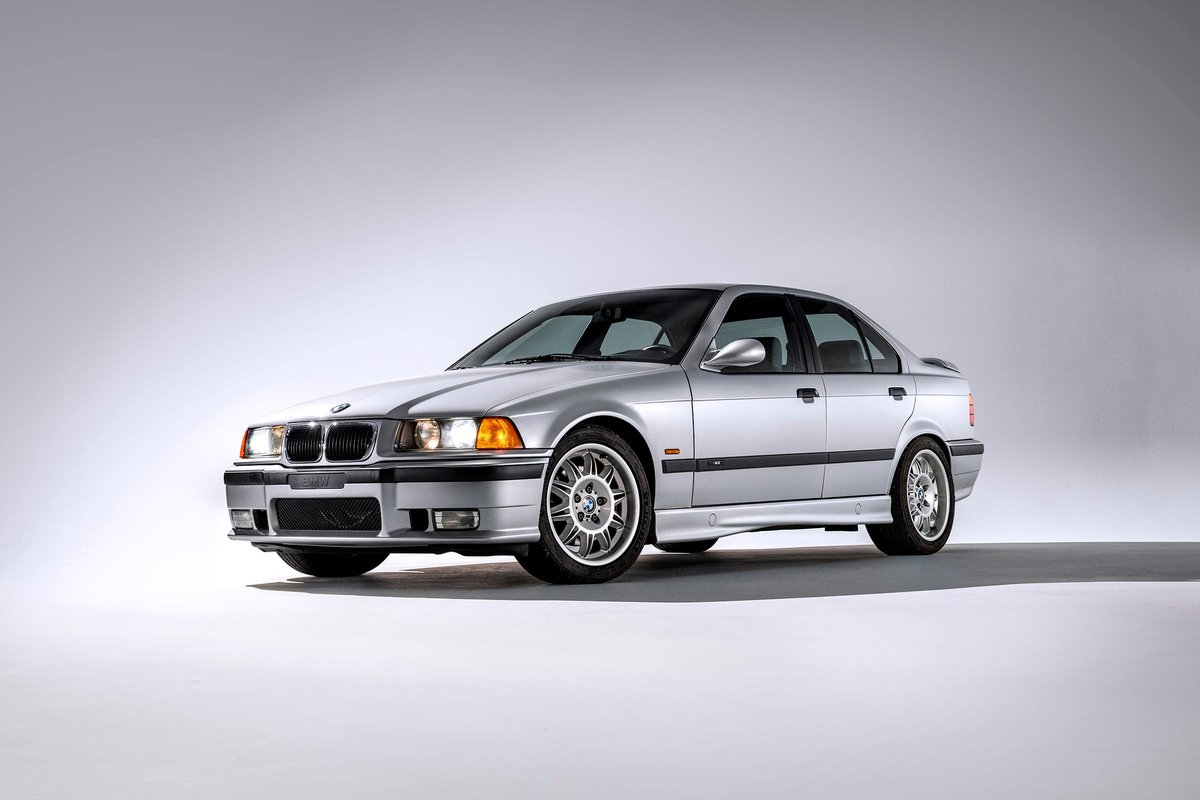
When BMW's M division rolled out the E36 M3: Refining the Formula (1992-1999), it wasn't just launching another performance car; it was redefining an icon. Gone was the angular, motorsport-derived aggression of its predecessor, replaced by a smoother, more sophisticated machine designed to be both a track weapon and a remarkably livable daily driver. This was the M3's coming-of-age, a pivotal moment that transitioned it from a homologation special into a performance icon, laying the groundwork for every M car that followed.
At a Glance: The E36 M3's Defining Traits
- A New Era for M: First M3 to feature a six-cylinder engine, setting a new standard for M car balance.
- Versatile Performance: Offered in coupé, sedan, and convertible body styles, proving M performance could be practical.
- European vs. US Divide: Distinct power outputs and specifications between Euro-spec (S50/S50B32, up to 321 hp) and US-spec (S52, 240 hp) models.
- The EVO Evolution: Mid-cycle refresh (1995-1999) brought a larger 3.2L engine, 6-speed manual, and double VANOS for European models.
- Driver-Focused Engineering: Near-perfect 50/50 weight distribution, a finely tuned suspension, and excellent steering feel.
- Modern Classic Status: Highly sought after by enthusiasts for its analogue driving experience, natural aspiration, and increasing collectibility.
- Ownership Considerations: Be mindful of common issues like VANOS, cooling system, and suspension components when buying.
From Homologation Special to Performance Icon
Before the E36, the M3 badge belonged almost exclusively to the E30 generation – a raw, homologation-special track car barely tamed for the road. It was glorious, but niche. BMW M's ambition for the E36 M3 was broader: to craft a high-performance machine that could conquer a race circuit on Saturday and comfortably ferry groceries or clients on Monday. This philosophy shifted the M3 from a strictly limited production "race car for the road" to a more accessible (though still exclusive) performance vehicle, fundamentally establishing the template for modern M cars with its exquisite balance of performance, practicality, and driver engagement. It was still built by the artisans at BMW M, but now on a scale that made it a true presence on roads worldwide. If you're keen to Explore BMW M3 generations, the E36 stands as a monumental bridge between old-school purity and modern capability.
The Heart of the Beast: Europe's S50 and S50B32 Engines
At the core of the European E36 M3's appeal was its magnificent straight-six engine. This marked a significant departure from the E30's four-cylinder, ushering in a new era of smooth, powerful, and sonorous M cars.
The Original S50B30: A Potent Debut
Launched in 1992, the initial European-spec E36 M3 coupé featured the S50B30, a 3.0-liter inline-six that immediately captivated drivers. This engine churned out a robust 286 horsepower (210 kW) and 320 Nm of torque, allowing the M3 to sprint from 0-60 mph in a swift 5.7 seconds. Its single VANOS (variable valve timing) system optimized valve overlap for a broad torque curve, making it thrilling both at low revs and near its impressive redline. It was a true testament to the evolution of BMW M engines.
The EVO Upgrade: More Power, More Sophistication (S50B32)
In 1995, the E36 M3 underwent a significant upgrade, dubbed the M3 EVO. This wasn't merely a facelift; it was a substantial refinement of the formula. The engine displacement grew to 3.2 liters, resulting in the S50B32 powerplant. Power jumped considerably to 321 horsepower (236 kW) and torque increased to 350 Nm.
Key to this power boost was the introduction of BMW's double VANOS system, which varied valve timing on both the intake and exhaust camshafts. This greatly improved efficiency across the rev range, enhancing both low-end torque and high-end power. The EVO also received a new Getrag 6-speed manual transmission, replacing the earlier 5-speed, allowing for better gear spacing and optimized performance. Other enhancements included:
- Sharper Steering Rack: For even more immediate feedback.
- Improved Limited-Slip Differential: Better power transfer to the road.
- Floating Brake Discs: Enhanced braking performance and heat dissipation.
- Weight-Saving Measures: Aluminum door panels and lighter alloy wheels, though overall weight remained similar due to added features.
This EVO iteration solidified the E36 M3's reputation as a world-class sports car, perfectly blending raw speed with refined drivability.
The American Interpretation: S52 and the Price Point Play
When the E36 M3 arrived in the United States in 1995, it did so with a slightly different heart. The US-spec model was powered by the S52 engine (initially the S50B30US in 1995, then the S52 from 1996 onwards), which produced 240 horsepower (179 kW) and 305 Nm of torque. This was a notable 46 horsepower less than the European EVO model and 46 hp less than the initial European 3.0L.
Why the difference? A combination of stricter US emissions regulations and BMW's strategic decision to hit a target price point of $35,000 for the American market. To achieve this, some cost-cutting measures were also implemented, such as different exhaust manifolds and simpler engine components compared to their European counterparts. While still a formidable performance machine, the US-spec M3 offered a slightly less aggressive experience, a trade-off for broader market accessibility.
Despite the power disparity, the US-spec E36 M3 remained incredibly popular, thanks to its superb chassis, handling, and timeless design. It was still head and shoulders above many of its contemporary rivals in its class. Only a precious few, fewer than 5,000 manual transmission examples, were shipped to the US, making them particularly coveted today.
A Body for Every Driver: Coupé, Sedan, and Convertible
One of the E36 M3's most significant innovations was its availability in multiple body styles, a first for the M3 badge. This decision was crucial in broadening its appeal and cemented its role as a practical performance car.
- The Coupé (1992-1998): The original and arguably most iconic E36 M3 form. It debuted in Europe in 1992 and in the US in 1995. Its sleek two-door silhouette perfectly encapsulated the M3's sporty intentions.
- The Sedan (1994-1997): A game-changer, the four-door M3 sedan arrived in 1994 (Europe) and 1995 (US). It offered all the M3's performance credentials with the added practicality of rear doors, proving that a family car could also be an enthusiast's dream. Only 12,603 sedans were produced globally, making them a unique find today.
- The Convertible (1994-1999): For those who loved open-air motoring, the M3 convertible debuted in 1994 (Europe) and 1995 (US), extending its production until 1999. It blended performance with a relaxed cruising capability, albeit with a slight weight penalty. A total of 12,114 convertibles left the factory.
All three body styles benefited from the E36's renowned chassis, featuring near-perfect 50/50 weight distribution and a well-tuned suspension that delivered an intoxicating blend of comfort and dynamic prowess. The production timeline saw the European coupé launch in 1992, followed by the sedan and convertible in 1994. The EVO updates rolled out for the coupé and convertible in 1995, extending to the sedan in 1996. Sedan production ceased in 1997, coupé in 1998, with convertibles being the last to roll off the line in 1999. In total, 71,242 E36 M3s were produced, a testament to its mass appeal.
Exclusivity Defined: Rare and Limited Editions
Beyond the standard production models, BMW M also crafted several special editions, making certain E36 M3s even more desirable and collectible today.
- European M3 GT (356 units, 1995): A homologation special finished exclusively in British Racing Green, featuring an adjustable rear spoiler, front splitter, aluminum doors, and a slightly uprated S50B30 engine (295 hp). These were built for GT racing.
- European M3 GTR (Road-going version of a GT Touring Car racer): An extremely rare, truly hardcore road-legal version of the GT Touring Car racer, built in very limited numbers.
- North American M3 Lightweight (126 units, 1995): Exclusively for the US market, these Alpine White track-focused machines were stripped of non-essentials like air conditioning, radio, and sound deadening. They featured aluminum doors, an adjustable rear wing, and unique M-motif livery. Many came with a factory-supplied "track in a box" kit, including cross-brace, spacer blocks, and instructions for spoiler installation.
- M3 Evolution Imola Individual (50 units, 1999): A UK-exclusive run, painted in striking Imola Red, featuring unique interior trim.
- M3-R (15 units, 1994): An Australian exclusive, requiring a racing license to purchase. These were potent track weapons with significant engine and chassis upgrades.
- Canadian Edition (45 units, 1994): Essentially European-spec M3s officially imported to Canada, offering the higher power output before the US-spec cars arrived.
These limited editions underscore the E36 M3's diverse legacy and appeal to different segments of the performance driving community. Their rarity and unique features make them highly prized by collectors.
Living with a Legend: Common Ownership Challenges
While the E36 M3 is renowned for its robustness and build quality, owning a classic performance car from the 90s means being prepared for certain common issues. A proactive approach and a thorough pre-purchase inspection are key. For anyone buying a classic BMW, these points are critical.
- VANOS System Woes: The variable valve timing system, especially the early single VANOS, can develop issues. Symptoms include rough idle, reduced power, and a "marbly" sound. Rebuilding or replacing the VANOS unit is a common maintenance item. Understanding BMW's VANOS system is crucial for E36 M3 owners, as proper function is vital to engine performance.
- Aging Cooling System: Plastic components in the cooling system (radiator, expansion tank, thermostat housing, water pump impeller) are prone to becoming brittle and failing over time, leading to overheating. A complete cooling system refresh every 60,000-80,000 miles is highly recommended as a preventative measure.
- Electrical Gremlins: Like many cars of its era, the E36 can suffer from electrical issues. Common culprits include failing window regulators, sticky central locking, and intermittent dashboard lights. Many are minor, but patience (or a good auto electrician) is often required.
- Worn Suspension Bushings: The chassis is fantastic, but rubber bushings and mounts degrade over decades. Worn control arm bushings, rear trailing arm bushings (RTABs), and subframe bushings can lead to vague handling, clunks, and excessive tire wear. Upgrading to stiffer polyurethane or spherical bearings is a popular choice for common M car performance upgrades to restore or even enhance handling.
- Rust: While generally well-protected, inspect common rust spots, particularly around the rear wheel arches, jacking points, and underneath the battery tray.
- Differential Mounts: The rear differential mount can fail, leading to clunking during gear changes, especially under load. This is another area for careful inspection.
The most crucial advice when considering an E36 M3 purchase is to insist on a comprehensive service history. Preventative maintenance, particularly for the cooling system and VANOS, will save you headaches and expense down the line. Many of these cars are now over 20 years old, so expect to invest in some deferred maintenance if you want it running optimally.
The E36 M3 Today: A Modern Classic's Ascent
The E36 M3 has confidently transitioned into the realm of modern classics. Its collectibility has been steadily climbing for several compelling reasons:
- Rarity and Attrition: With over 71,000 units produced, it wasn't a limited run like the raw, homologation-special E30 M3, but many have been lost to accidents, neglect, or heavy track use. Finding a well-preserved, unmolested example is increasingly challenging.
- Historical Significance: It's increasingly recognized as the M3 that fundamentally redefined the M car formula, proving a sports car could be both track-capable and a genuine daily driver.
- Naturally Aspirated Purity: In an era dominated by turbocharging, the E36 M3's naturally aspirated inline-six offers a direct, linear power delivery and an intoxicating exhaust note that purists cherish.
- 1990s Nostalgia: For a generation of enthusiasts who grew up with posters of these cars on their walls, the E36 M3 embodies a beloved era of automotive design and engineering.
- The "Sweet Spot": Many consider the E36 M3 to occupy a "sweet spot" in automotive history. It offers modern performance and refinement before widespread electronic aids began to filter the driving experience. It demands involvement and rewards skill, providing a pure connection between driver and machine.
Unsurprisingly, European EVO models, especially the 3.2L versions with their 6-speed manual transmissions, command the highest premiums due to their higher power output and advanced drivetrain. Rare limited editions, like the M3 Lightweight or M3 GT, are in a league of their own. Low-mileage examples in desirable colors with extensive service records are fetching top dollar, indicating a strong and growing appreciation for this pivotal M car.
Your Next Drive: Finding the Right E36 M3
If the E36 M3 has captured your imagination, the journey to ownership is a rewarding one. Here's how to navigate it:
Define Your Priorities
- Performance vs. Price: Decide if the higher-horsepower European EVO (if you're outside the US or willing to import) is worth the premium, or if the US-spec S52 offers enough thrills for your budget. Remember, even the US-spec cars are fantastic drivers.
- Body Style: Do you prioritize the coupé's classic lines, the sedan's practicality, or the convertible's open-air experience? Each has its unique charm and market value. Sedans and convertibles, while slightly less rigid, offer different ownership experiences.
- Intended Use: Will it be a daily driver, a weekend toy, or a track car? This will influence the level of modifications you're comfortable with and the condition you seek. A well-maintained daily driver might be less pristine than a garaged show car.
The Search and Inspection
- Look for Records: A comprehensive service history is non-negotiable. It tells you how well the car has been maintained, what common issues have been addressed, and what might be due soon.
- Pre-Purchase Inspection (PPI): Have a trusted BMW specialist inspect the car thoroughly. Pay close attention to the cooling system, VANOS, suspension bushings, and subframe integrity – these are common failure points and expensive fixes.
- Rust Check: Visually inspect common rust areas, especially the rear wheel arches, rocker panels, and jacking points. Don't forget under the battery tray in the trunk.
- Modifications: Be wary of excessively modified cars unless you know the quality of the work and it aligns with your goals. Often, an unmolested, well-maintained example is a better starting point for your own enhancements.
- Test Drive: Listen for any unusual noises (clunks, whines, rattles), feel for vibrations, and assess the steering, braking, and clutch engagement. Ensure all gears engage smoothly, especially in the 6-speed EVO. Pay attention to how the engine pulls through the rev range – any flat spots could indicate VANOS or sensor issues.
The E36 M3 remains a compelling choice for enthusiasts seeking a classic sports car that combines accessible performance, timeless design, and growing collectible status. It's a machine that demands your involvement and rewards you with one of the purest driving experiences BMW has ever offered. Get behind the wheel of a well-sorted E36 M3, and you'll understand why it truly refined the M car formula for a new era.